
Press Play: Dimitris Theocharis on Music, Creativity and Evolution
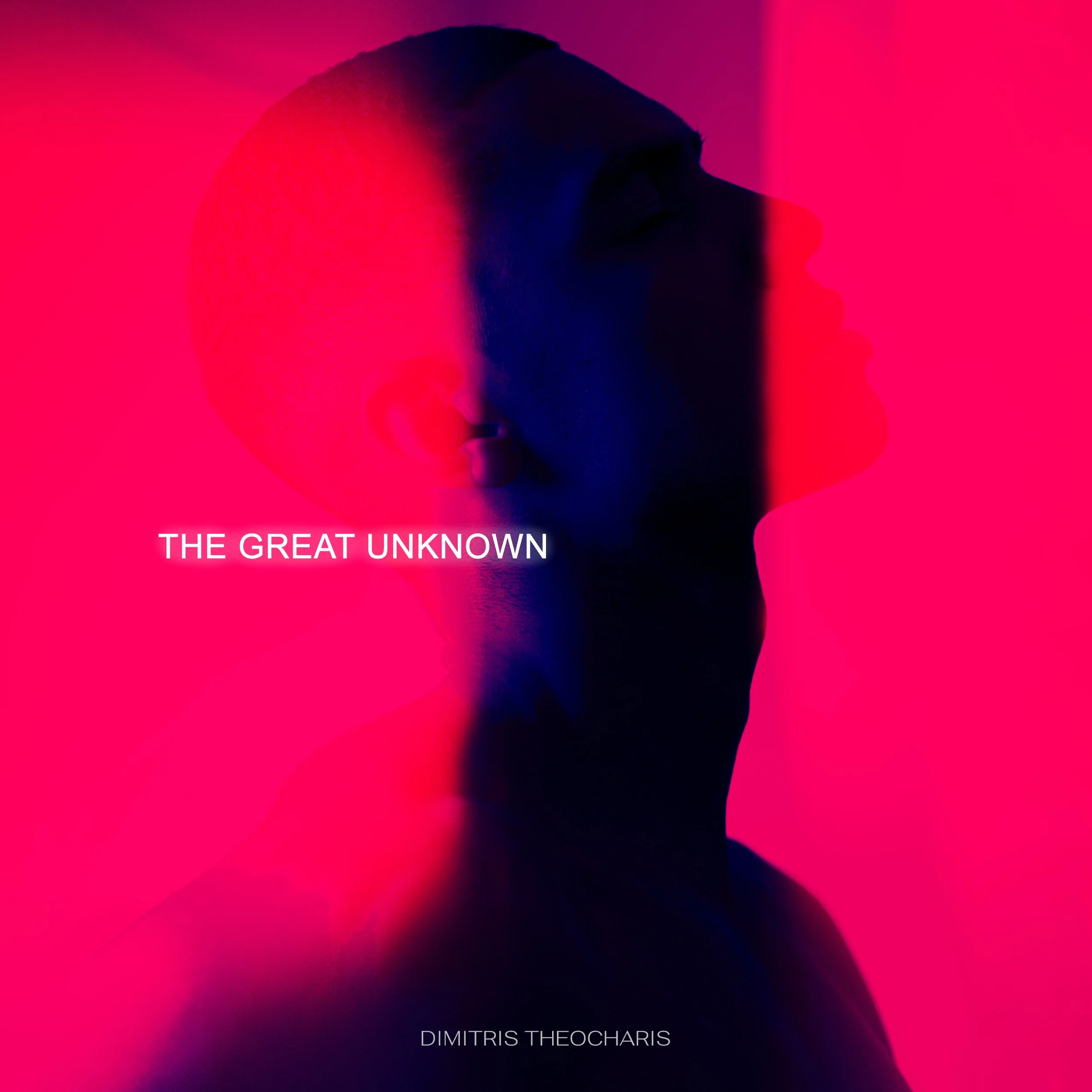
Few creatives translate atmosphere across mediums as instinctively as Dimitris Theocharis. Known for constructing images that feel both cinematic and emotionally charged, he now channels that same intensity into sound with The Great Unknown — a two-part electronic concept album that unfolds like a psychological journey.
At REY, we’ve long admired Dimitris Theocharis for his ability to create worlds — and this might be his most personal one yet.
When did you realize this would become a concept album rather than just a collection of tracks?
It wasn’t a single moment but rather a process. It all started while I was refining a track called Game Over in June 2025 which I had originally planned to release as an EP. Whilst I was still in the editing process, new lyrics and ideas for songs started flooding my head, including fragments that would later become In This Life and Post Love. That’s when I realized I was in a creative flow and decided to direct that energy toward a specific concept. Pandora’s Box and the seven deadly sins became loose reference points for the album, as I wanted to write and create songs reflecting both my observations of the world and my own journey through it.
The album moves from external observation to internal transformation. Was that duality something you planned from the start?
Although some of it was intentional, it also emerged naturally. In contrast to my first album, which was more spiritual and up in the ether, I wanted to get my hands dirty, so to speak and engage with the current state of the world, its systems, contradictions and inevitably my own journey and life experiences. The shift from the external to the internal felt honest.
The themes of excess, desire, and control feel very current. Were you reflecting society, or something more personal?
Primarily the societal structure we’ve inherited and continue to perpetuate. It’s built around control and manipulation. Nothing new, but nowadays it feels far more evident in almost every aspect of our lives. The “watchful eye of God” has now become an algorithm that tracks and analyses every step. The question is to what end? How is the access to every small detail of our lives being used? Is there a way out? Are we eventually going to be subscribing to freedom? Could living off-grid become a utopia? Or is utopia a state of mind? Desire has been reduced to swiping left or right, to momentary satisfaction that leads nowhere and ultimately means nothing, as expressed in Pleasure on Repeat, a song partly inspired by gay club culture and chemsex parties. It comes from a very real need for human connection, yet there’s something deeply ephemeral and addictive about the way we deal with desire that resembles a quick fix, void of emotional depth. I quite like how this song exists in two versions within the album. The electronic version feels innocent and fragile whereas the acoustic version feels more mature, sung from experience, almost with hindsight and wisdom. Then Money starts with the question: how much does your life cost? A very strong statement derived from the expression “time is money.” If time is money, then a lifetime has a price. That’s a disturbing conclusion, but as abrupt as it sounds, we live in a society that is addicted to consumption on every level and the pursuit of wealth.
The Sanskrit message, “it is never enough,” feels like the spine of the project. Why was that the idea that anchored everything?
Because it’s universal. It cuts through culture, time, and identity. That endless cycle of wanting more is both the cause of suffering and the force that drives change. It drives everything forward, but it also traps us. Once that became clear, everything else aligned around it.
Utopia is a clear turning point. What does that moment represent for you creatively and emotionally?
Utopia is a state of mind. It’s a pause. A bridge. Up until that point, everything is outward-facing and observational. Utopia breaks that momentum and demands stillness. It represents the desire, or perhaps the need, to escape from everything negative happening around us. It asks us to stop for a moment, breathe, and reconnect with what still exists: the sun, the sea, nature, ourselves. When all the noise stops, the senses awaken again. But underneath that stillness, the storm is always near. The lingering fear of war, destruction and collapse remains.
The second half of the album feels more vulnerable. Was it harder to create than the first?
Not really. The first half was actually harder because it’s more controlled. The political, philosophical, and existential themes pushed me technically as a writer and forced me to experiment more with genre, sound and structure. The second half required letting go of that control. I was more exposed, less protected by the concept itself, but I was entering a more familiar territory as I’ve always been drawn to emotionally charged and introspective music. The real challenges were Illusive Reality, Eternal Youth, Dominion, and Post Love. For example, with Post Love, I didn’t want it to become melodramatic or fall into the typical clichés that come with breakup songs. I wanted it to remain honest, dignified, minimal, and personal, while still open enough for listeners to project their own experiences. Those songs were difficult to finish. I probably wrote several hundred variations.
Tracks like Money and Dominion feel powerful and confrontational, while Post Love and Vein feel intimate. Do you approach them differently when producing?
Yes, the approach shifts with intention. The wording is always carefully considered, but the complexity, structure and nuance differ significantly. Money moves between the ridiculous yet very real demands and expectations of modern life, expressed through a climactic rap that builds toward the anxiety of chasing money to meet those demands. The melodic, almost mantra-like chorus softens that tension and creates a playful balance between fixation and release. Dominion is more restrained, almost void of melodic elements, yet sonically very cinematic, as I was attempting to recreate a sonic war zone. By reinterpreting quotes from the Book of Genesis as a gender-neutral intro and outro, I created parentheses within which I could reflect on our systems’ obsession with dominance and power, and ultimately the destructive nature of that. Post Love is a deconstructed verse-chorus song. I flipped the structure around, using the first verse as a fragile, poetic and melodic intro, while transforming the initial spoken “dear diary” intro into the central section of the track, concluding with a mantra-like ode to love where past, post, lost, last and new love merge into one. Vein works more instinctively, something that unfolds rather than being consciously constructed. It reads as a love song, but was in fact inspired by the treatments I received related to a health issue I faced last year. I kept it in its pure acoustic form, as I felt the emotional weight was amplified through its simplicity. Technically, the process differs, as does the mindset. However, each track reveals a different part of the same story.
Do you have a favorite track, or one that feels closest to who you are right now?
Possibly Vein. It was probably the easiest song to write because it came very naturally, however, each track is dear to me. Right now I’m trying to decide which track to remix next. I’m somewhere between Pleasure on Repeat and Dominion. Any suggestions?
The soundscape is constantly shifting. How do you balance experimentation with cohesion?
By staying anchored to the emotional and conceptual core. The sound can evolve, but the intention remains consistent. Utopia also plays an important role in that balance, as it shifts the perspective of the album. Cohesion doesn’t necessarily come from repetition. It can also emerge through progression, juxtaposition, or clarity of purpose. I think the album creates a sonic arc where the listener moves through different genres and emotional states while still remaining connected to the main idea.
As a fashion photographer, your work is highly visual. Do you “see” your music in images as you create it?
Most of the time, yes. Whilst putting the album together, I kept visualizing the tracks as part of a dark, dystopian, futuristic musical, with my fictional heroine Domina moving through the various stages and emotional states of the album. The opening track acts as both an introduction to adulthood and an entry point into the space of The Great Unknown - Earth? the human mind? Or perhaps both - where everything is possible…
Is there a direct dialogue between your photography and your music, or do they exist as separate expressions?
There is definitely a dialogue between them, but I believe each medium ultimately stands on its own merits.
If The Great Unknown had a visual campaign, what would it look like?
I had several visual ideas for the first seven tracks, mostly inspired by a twisted post-apocalyptic, dystopia, decayed luxury, and fragmented human connection. Unfortunately, I didn’t have the time to fully explore that direction this time.
How does fashion influence your sound, if at all?
Fashion deals a lot with identity, projection, and transformation. Those ideas are deeply embedded in my approach to music.
What’s next for you, are you leaning more into music, or continuing to merge both worlds?
The goal isn’t to choose one over the other, but to explore how both forms can coexist and eventually merge more deeply. That intersection is where things could become more interesting for me.
And for REY, anything exclusive you can share about what’s coming next?
There’s definitely more music coming soon. Alongside that, I’m working on my photography book and exhibition.