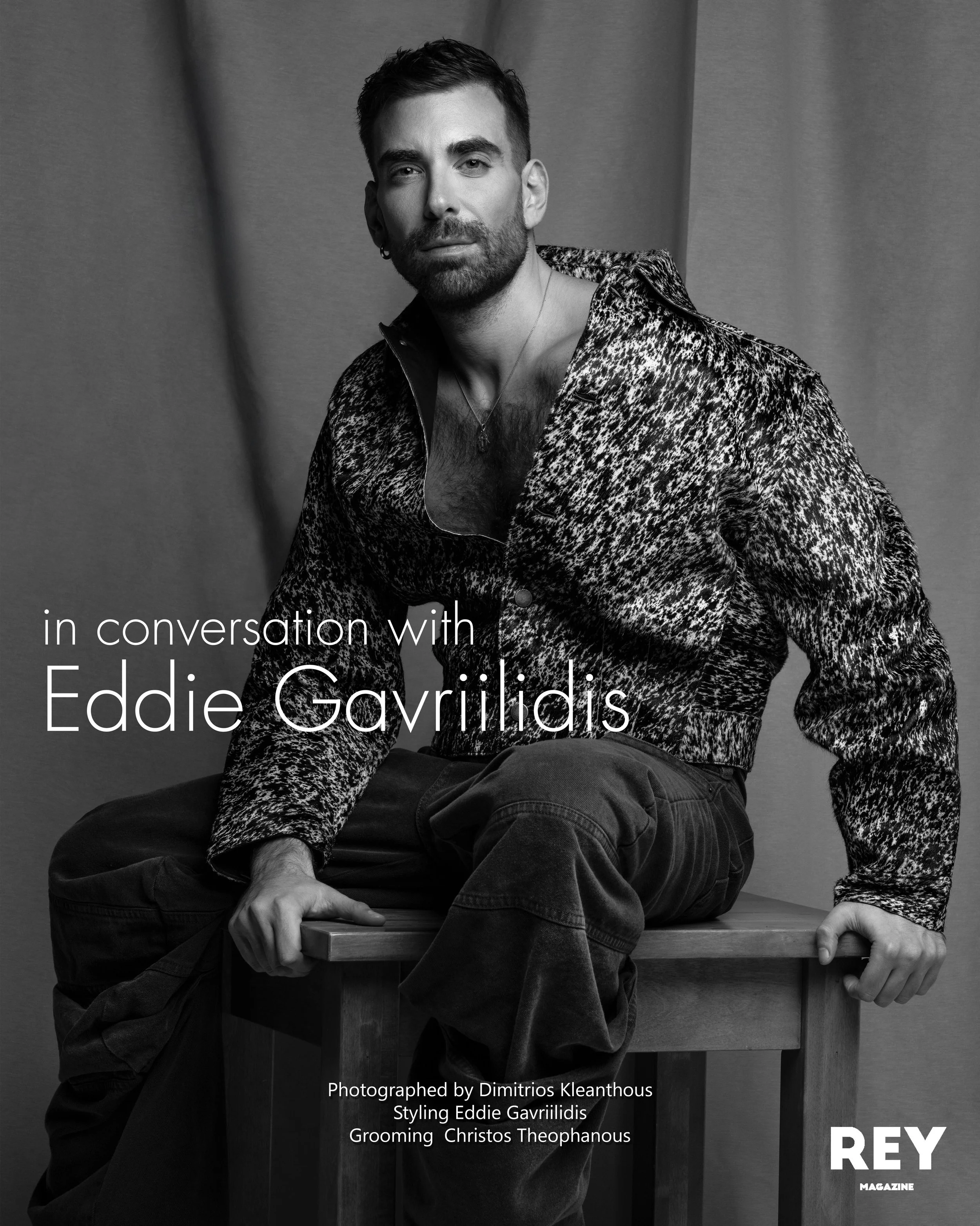
In Conversation with Eddie Gavriilidis
Eddie Gavriilidis is one of the most compelling voices in contemporary fashion, blending Mediterranean heritage with bold queer expression. As the co-founder of House of Jaffa and a rising force on the international stage, he challenges conventions with authenticity and intention. In this conversation for REY Magazine, Eddie opens up about creativity, identity, and the power of visibility.
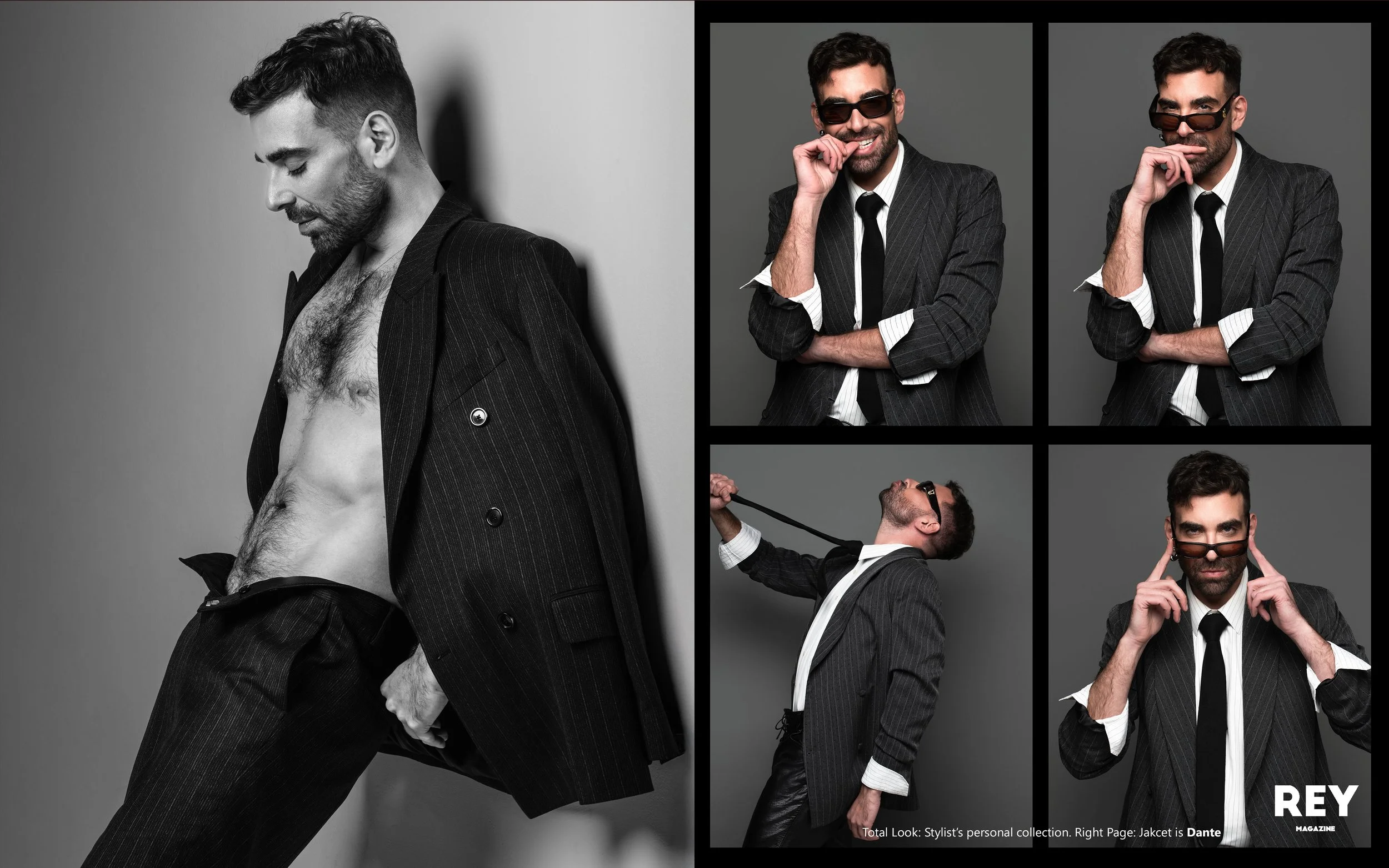
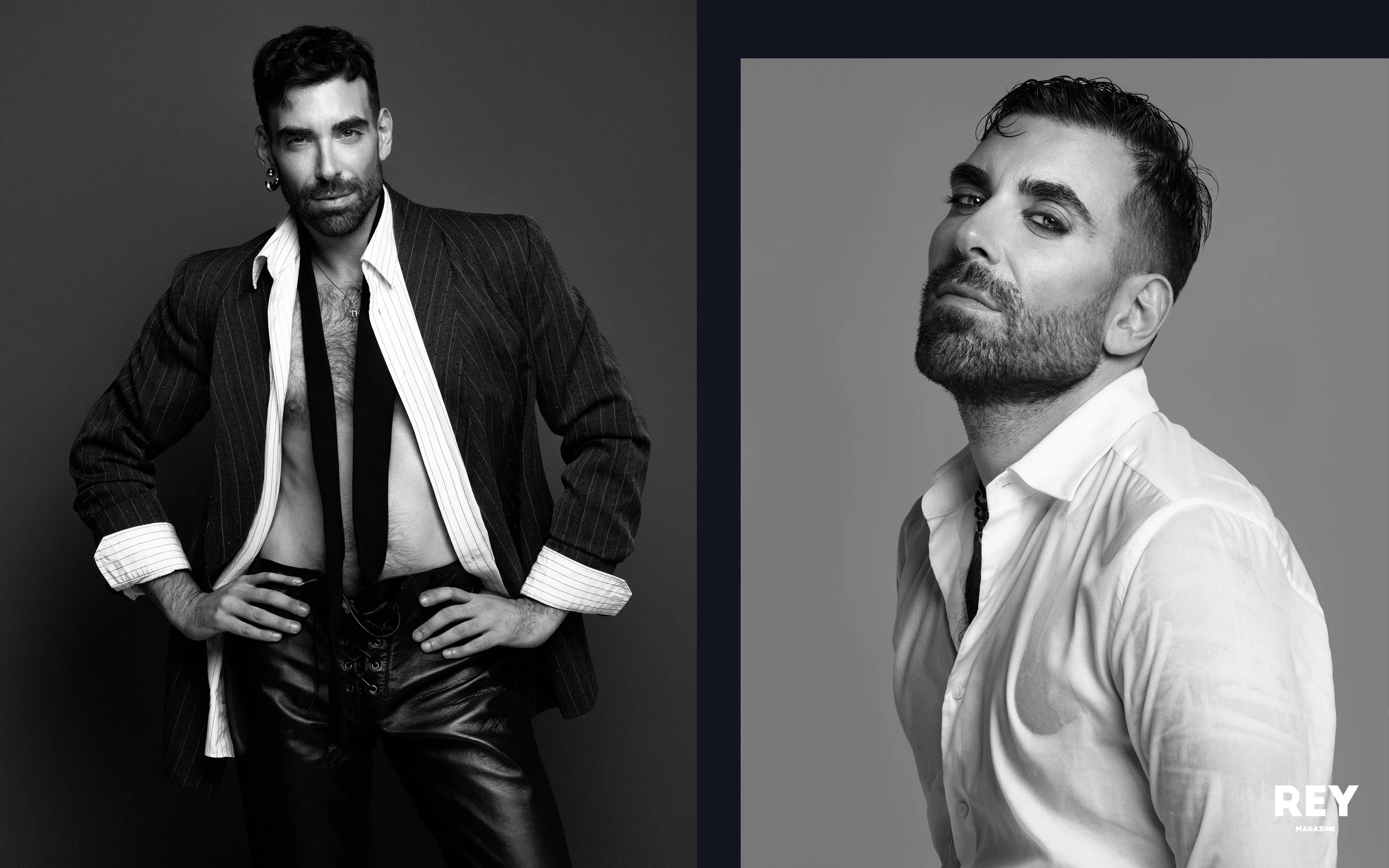
Photographed by Dimitrios Kleanthous
Styling Eddie Gavriilidis
Grooming Christos Theophanous
Interviewed by Christos Christou
Your journey has taken you from Greece to London and into the global fashion world. What was the turning point when you knew fashion was your calling?
Grew up inside art. My mother studied at the National School of Fine Arts in Athens, my father lived in fashion, so creativity wasn’t a choice it was the air. I had the references before I had the words. Passion showed up early, discipline came later on when I went to Central Saint Martins & Marangoni.
Somewhere between obsession, temptation and hard work, I stopped being a kid and became something new. A new person that had the guts to dress Gaga and Madonna, live, create fall in love and party hard with Lindsay Lohan. ;)
You’ve worked with major houses like Alexander McQueen and Tom Ford. What’s one lesson from those environments that continues to shape your design DNA?
At McQueen, I was designing embroideries, and my creativity was pushed to its limits. I learned how to illustrate emotion — that nothing is accidental, that chaos only works when it’s controlled. Tom Ford was the most charming person I’ve ever met. He introduced me to the world of fashion marketing and branding, where sexuality stopped being a taboo and became powerful, refined, and confident. I worked on pieces later worn by Anna Wintour, even at a dinner with Barack Obama — that was the moment I realized my work can reach a massive audience and the power to be seen by millions around the world.
Your work often challenges traditional gender and beauty norms. How do you approach designing for people rather than for categories?
I don’t design for genders; I design for desire. Bodies are just vessels; attitude is the real silhouette. When you strip the rules away, what’s left is power, vulnerability, sex. That’s where my work lives. Clothes should flirt, provoke, and give people the choice to define themselves. Fashion is language it shows our ethos, who we are or who we want to be, before we ever speak. Look at Madonna: from the very beginning, her fashion spoke first. Provocative, conceptual, fearless — you knew exactly what she wanted to say before she even started singing.
You joined Greece’s Next Top Model as one of the main judges, bringing a fresh and international perspective to the show. How did this opportunity come to you, and what made you say yes?
I’m always surrounded by people who push me further. A friend suggested it, the timing felt right, TV came when I was ready. I wanted to shake things up and push the girls and the boys, make them see fashion isn’t just clothes. It’s attitude, confidence, owning your story. I wanted to bring the global, modern edge that I’ve learned in Europe working with mega brands such as Burberry, Erdem and Victoria Beckham. Also Fashion people are real people bold, alive, part of life, not stuck in a bubble.
Stepping into the GNTM judging panel introduced you to a new level of visibility and connection with emerging talent—how has that experience, along with the responsibility it carries, influenced you personally and creatively?
GNTM isn’t just judging, it’s feeding off the fearless boys and girls, breaking rules, and keeping everything real. It pushes me to take risks I might never have tried on my own. Watching them claim their space reminds me why I do what I do. We create, to challenge, and to make people feel alive and stronger. I wanted the models to break the norms and find an unapologetic existence, that’s the kye from a model to become a super model.
Fashion today is deeply connected to personal storytelling. With House of Jaffa’s bold Queer Middle Eastern aesthetic, what story were you aiming to tell when you founded the brand, and how has that vision evolved through your work today?
House of Jaffa was born in London, but its soul comes from Jaffa — the port of Andromeda, where the sky bleeds into the sea. I’ve always been obsessed with the constellations that guided travellers, the myths of heroes like the Dioscuri, and the raw, electric energy of bodies in motion. Our designs are charged with desire, with tension, a celebration of bold, fearless beauty. House of Jaffa isn’t about borders or labels it’s about the journey, the fire, the light, and the thrill of being unapologetically you.
The label blends Mediterranean romanticism with gender-fluid silhouettes. How do cultural roots influence your creativity?
I’m Greek, but my heritage traces back to merchants who moved from Spain to Italy, through Asia Minor, and into Greece. Golan comes from French, Moroccan, and Egyptian roots, with a grandfather who was a diplomat and a father who grew up all across Africa. We both carry layered histories, and grew up on varied and rich iconography and superstitions. We fused all of that with our London multiculturalism education.
Our creative start point comes from the Mediterranean sun on bare, tanned skin, the heat in August that makes you sweat and burn with desire.
House of Jaffa explores identity, sensuality, and freedom. In today’s climate, do you feel fashion can still be a form of activism?
Fashion is the body, desire, and danger you wear. At House of Jaffa, every piece drips with lust, tension, and skin-on-skin heat, it provokes, it questions, it seduces. Dressing isn’t just clothes; it’s an act, a performance, a little rebellion you carry on your own body.
You and Golan Frydman co-founded House of Jaffa. How would you describe your creative chemistry?
Working with Golan is love and trust in motion. We play ping-pong with ideas until a new monster is born wild, raw, demanding attention. Then we tame it, illustrate it, dress it in silks, cottons, and linens, and bring it to life
Many creative duos struggle with balancing personal and professional life.How do you and Golan maintain harmony between the two?
of course we do. It’s a challenge like any couple. But the silver lining? Our work fuels our chemistry. We fight, we laugh, we push each other… and sometimes the tension turns into something electric. That energy seeps into the brand, making it bolder, wilder, and undeniably alive.
As one of the few Greek fashion figures who is openly gay and open about your relationship with Golan, what does that visibility mean to you personally and creatively?
Fuck the Homophobes, they are medieval suppressed little beings.
I spent my adult life in London sexuality, origin, gender… none of it’s a label there. It’s just life. We’re all different. That’s the point. What matters is embracing love, companionship, and celebrating who we are.
In a time when LGBTQ+ rights are being challenged globally, what do you believe the queer community needs most right now?
I don’t do speeches, that’s not me. But here’s the truth: queer people are just people. No apologies, no labels, we live, we desire, we move through the world like anyone else. And when rights are taken away, that’s when you get up and fight. Make space for a better future.
What’s next for the House of Jaffa?
The brand started in the shadows, cruising, hushed lust, back-alley encounters behind the Ottoman hammam. Now, House of Jaffa is diving headfirst into myth, desire, and Mediterranean heat. We’re twisting the story of Andromeda, tied to the rock to be sacrificed, and the Dioscuri, two brothers who died for each other’s love. Moments where gods, monsters, and humans collide in lust and vanity. And here’s a scoop for you… ;) After shows in London, Paris, and Jaffa, our next stop will be Athens this May.
And finally — what does freedom mean to Eddie?
Freedom… Is doing what I want. Living, creating, and moving through the world without caring what labels others choose to use for me, their gossip, their shallow ideas about me are meaningless. And freedom from this means Following my instincts, taking risks, making mistakes, and owning it all.